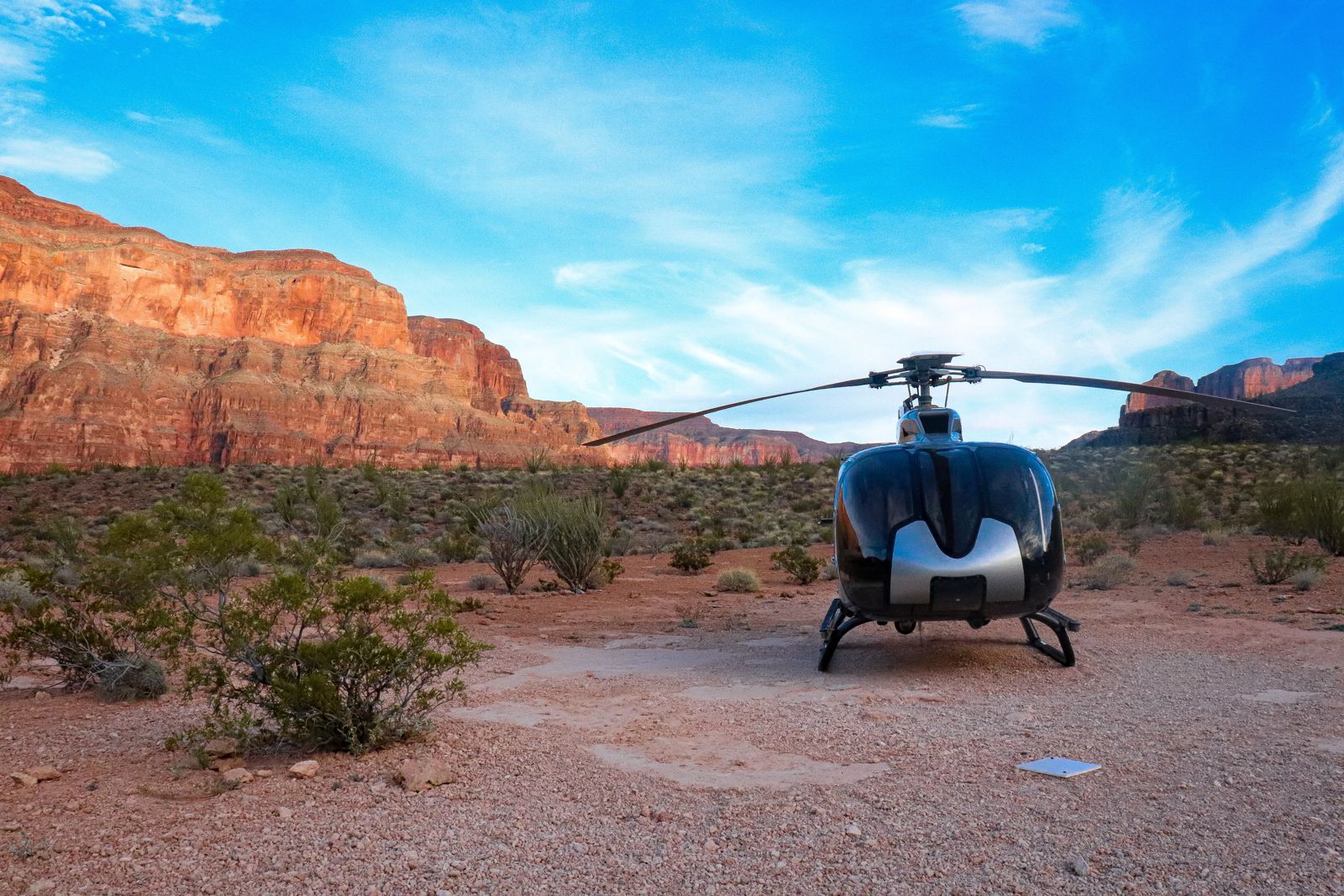
Grand Canyon Helicopter Tours: South Rim, Las Vegas and West Rim Flights Compared
“Grand Canyon helicopter tour” covers three quite different trips, and they start in three different places.
- From Tusayan, at the South Rim. Short sightseeing flights from Grand Canyon Airport, just south of the national park, out over the canyon toward the North Rim and back. You stay in the air the whole time.
- From Las Vegas. Longer trips that fly east over Lake Mead and the Hoover Dam to Grand Canyon West, at the western end of the canyon. Some land below the rim, on a bluff above the Colorado River.
- At Grand Canyon West itself. Short flights run by the Hualapai Tribe from the West Rim down to the river and back, often paired with a boat ride.
The difference that matters most is where you land, if at all. The National Park Service says all scenic air tours are based outside Grand Canyon National Park, and federal rules keep aircraft out of large flight-free zones over it. The flights that come down below the rim, among the listings this guide compares, are the ones at Grand Canyon West, which is on the Hualapai Reservation and outside the national park. This guide compares each kind, the rules behind them, and how a flight compares with seeing the canyon by bus or by train.
The three kinds of flight at a glance
| From Tusayan (South Rim) | From Las Vegas | At Grand Canyon West | |
|---|---|---|---|
| Starts at | Grand Canyon Airport, Tusayan | A Las Vegas heliport; you make your own way there | The West Rim helicopter terminal |
| Flight | About 45 minutes on the listings here | About 45 minutes each way, about 2.5 hours in all | About 15 minutes, down and back |
| Lands in the canyon? | No | Yes, on a private bluff above the Colorado River | Yes, at the bottom of the canyon |
| Land below | Grand Canyon National Park | Lake Mead, Hoover Dam, then Hualapai land | Hualapai land |
| Who it suits | People already staying at the South Rim | A half day from Las Vegas without the long drive | People already at the West Rim |
Flights from Tusayan, over the national park
Tusayan is the small town 6 miles south of the park’s South Entrance, and Grand Canyon Airport is there, south of the park boundary. The National Park Service says fixed-wing and helicopter tours of the region run daily, and the Arizona Department of Transportation lists three helicopter tour operators and two fixed-wing operators at the airport.
These flights do not land in the canyon. They take off from the airport, cross the forest to the rim, fly over the canyon on set routes and come back. Two listings on our tours page show the range:
The 45-minute flight. On its listing, this flight leaves Grand Canyon Airport over the ponderosa pines of the Kaibab National Forest, follows the Colorado River upstream with the Painted Desert and the Desert View Watchtower in the distance, passes Marble Canyon and Point Imperial, climbs above the North Rim and heads south through the Dragon Corridor, which the listing calls the canyon’s widest and deepest section. Taxes and fees are included; hotel transfers and tips are not.
The flight with a Hummer option. This one, on its listing, is a narrated flight of 40 to 50 minutes along the edge of the South Rim and across the canyon, with the Colorado River, the North and East Rims, Imperial Point and the Dragon Corridor below. Each helicopter carries up to six passengers. You can add a 2-hour guided tour of rim viewpoints in an open-air Hummer. The listing asks you to bring $15 per person for a fuel surcharge and to check in 30 minutes before departure.
Which to pick comes down to what else you want from the day: the flights are a similar length, and the second one is the way to add a guided ground tour of the rim.
Do you pay park fees for a flight from Tusayan? The flight itself starts and ends outside the park. The Hummer listing says the nonresident park fee applies to non-US residents aged 16 and over who choose the Hummer option, which goes into the park. If you also want to visit the South Rim on foot that day, you need a park pass in the usual way; see our tickets and prices guide.
The rules that shape every route
Air tours over the Grand Canyon are tightly regulated, which is why they follow fixed routes rather than flying wherever the view is best.
- Natural quiet is a legal goal. The 1987 Overflights Act requires the park to substantially restore natural quiet. On a peak day, the park’s noise modeling put that restoration at 55%, and it wants to go beyond the minimum level of 50%.
- Flight-free zones. Federal rules (14 CFR 93.305) set flight-free zones inside the Special Flight Rules Area, including the Desert View and Bright Angel zones, from the ground up to 14,500 feet.
- Corridors. Between those two zones runs the Zuni Point Corridor, 2 nautical miles wide for commercial air tours. Air tours fly set routes like this, and the South Rim listings name theirs: the Dragon Corridor.
The practical upshot: a flight from Tusayan shows you a long stretch of the canyon from above, on a set route, rather than wherever the pilot might choose.
Helicopter tours from Las Vegas
Las Vegas is about 278 miles from the South Rim by road, so its helicopter trips go the other way: east to Grand Canyon West, which the National Park Service puts 122 miles from the center of Las Vegas.
The helicopter landing tour listed on our site runs like this, by its own description:
- Getting there. You make your own way to the heliport in Las Vegas; hotel pickup is not included. You check in, get a safety briefing and board an Eco-Star helicopter, with up to seven passengers per aircraft.
- The flight out, about 45 minutes. Over Lake Las Vegas and Lake Mead, then the Hoover Dam and the Mike O’Callaghan-Pat Tillman Memorial Bridge, with recorded commentary in your headphones.
- The landing. On a private bluff at Grand Canyon West, overlooking the Colorado River. The listing puts it 3,500 feet below the rim and about 300 feet above the river, with a Champagne toast and a light snack under a traditional ramada.
- The flight back, about 45 minutes, alongside the Las Vegas Strip.
The listing gives about 2.5 hours in all. That makes it the quickest way, among the listings here, to get below the rim of the Grand Canyon from Las Vegas. Note that you land on a bluff above the river, not at the water’s edge.
What it does not include is the national park. Grand Canyon West is on Hualapai land, and the Skywalk there is not affiliated with Grand Canyon National Park, so neither park fees nor park viewpoints such as Mather Point are part of the trip.
Flights at Grand Canyon West
If you are already at the West Rim, on a coach tour or by car, the Hualapai Tribe sells its own helicopter flights there. Its Helicopter Pontoon Package, on the Grand Canyon West site in October 2026:
- Price: $418 per person, including the All-Access Pass (which on its own is $99 and covers the Skywalk).
- The flight: down 3,500 feet to the bottom of the canyon and back up, about 15 minutes of flying in all.
- The river: a narrated boat ride on the Colorado, about 15 minutes.
- Total: about 45 minutes; check in 1 hour before your flight at the helicopter terminal next to Terminal 1.
- Limits: age and weight restrictions apply, so read them before you book.
Because Grand Canyon West sells its last ticket at 4:30 p.m. and opens its doors at 8:00 a.m., a flight has to fit inside that day. Note that its hours are given in Arizona time, which matches Las Vegas time from March 8 to November 1, 2026 and then switches to Mountain Standard Time; check which clock a booking uses.
What else is at Grand Canyon West
A flight at the West Rim is usually one part of a longer visit, and the ground has three main stops, linked by the free hop-on, hop-off shuttle:
- Eagle Point: the Skywalk, the Eagle Rock formation and the Native American Village. The Skywalk is a 10-foot-wide horseshoe of glass that extends 70 feet out over the rim, with the canyon floor 4,000 feet below. Bags are not allowed on the glass, so belongings go in a free locker, and everyone wears booties over their shoes.
- Guano Point: wide views and rugged hiking trails. The West Rim coach tour on our site stops at both Eagle Point and Guano Point.
- Hualapai Point: the zipline, which crosses 1,100 feet between the canyon walls, plus cabins and food. Zipline riders must weigh between 90 and 275 pounds and be at least 4 feet tall.
Parking is offsite, with the shuttle running to the Skywalk. If you are combining a flight with the Skywalk, remember that Skywalk entry on the All-Access Pass is valid only on the day your pass is first scanned.
Helicopter, bus, train or Skywalk?
A helicopter is the fastest way to see a lot of canyon, but it is not the only way and not always the best one. Here is how the main products on our tours page compare by the length of the day, from their listings:
| Trip | Length | What you get |
|---|---|---|
| South Rim scenic flight from Tusayan | 45 minutes | The central and eastern canyon from the air |
| Flight with Hummer option | 45 minutes, plus 2 hours if you add the Hummer | A flight, plus rim viewpoints by Hummer if added |
| Helicopter landing tour from Las Vegas | 2.5 hours | Lake Mead, the Hoover Dam and a landing below the rim at the West Rim |
| West Rim day trip by coach from Las Vegas | 10 to 11 hours | About 3.5 hours at Grand Canyon West, the Skywalk as an option |
| Small-group tour from Flagstaff (or Sedona) | 9 hours (11 from Sedona) | Wupatki, Sunset Crater, then the East and South Rims |
| South Rim day trip by coach from Las Vegas | 13 hours | About three hours on the national park’s South Rim |
| Day trip from Phoenix via Sedona | 13 hours | Sedona, Oak Creek Canyon and about 2.5 hours in the park |
Some rules of thumb:
- If you are staying at the South Rim, a flight from Tusayan adds the one view you cannot get on foot, a long stretch of the canyon from above, in under an hour.
- If you are in Las Vegas for one day, the choice is between the national park by coach (a 13-hour day) and the West Rim, by coach or by helicopter. The helicopter landing tour gets you below the rim and back in about 2.5 hours.
- If what you want is time at the edge, the train from Williams or a ground tour gives you hours at the rim; a flight gives you minutes in the air.
- If you want the Skywalk, that is only at Grand Canyon West: the Sunset Pass ($59) and the All-Access Pass ($99) both include it, and the West Rim coach tour has it as an option.
What about getting to the river another way?
A helicopter at the West Rim is one of the few ways to reach the Colorado River in a day in 2026. The usual alternatives are limited in 2026:
- On foot from the South Rim. The flash flood of August 29, 2026 closed Phantom Ranch, both footbridges over the Colorado, the Bright Angel Trail below Mile-and-a-Half Resthouse and the South Kaibab Trail below the Tip-Off, according to the park’s hiking page. Hiking to the river from the South Rim is not possible until those sections reopen.
- By mule. The park says North Rim mule rides were cancelled in 2026 because of trail damage. South Rim rides are booked up to 15 months ahead; check what is actually running given the trail closures.
- By raft. The park notes that river trips through the canyon last from several days to three weeks, and there are no one-day river trips through its length. The Hualapai Tribe runs guided rafting from Peach Springs, about a 2-hour drive from Grand Canyon West.
Practical points before you fly
- Weather. Flights depend on it. In late summer, monsoon rains fall almost daily, usually in the afternoon, so a morning flight is the safer bet in those months.
- Photo ID. The flight listings say everyone 18 and over must show original government-issued photo ID at check-in, under FAA rules.
- Weight. The flight listings ask for each passenger’s weight at booking, and heavier passengers (over 275 or 300 pounds, depending on the listing) must buy a second seat. The Grand Canyon West flights also have age and weight restrictions; check them before you book, not at the terminal.
- Wheelchairs. The Las Vegas landing tour says wheelchairs cannot be accommodated because of the uneven ground at the landing site.
- Timing at the West Rim. The Skywalk’s busiest hours, by the Grand Canyon West site, are 11 a.m. to 3 p.m. A morning or late-afternoon slot avoids the worst of the crowds.
- Nonresident fees. These apply to the national park only. They are not charged for a flight that stays outside the park or for Grand Canyon West.
For the drive and the coach trips from Las Vegas, Flagstaff and Phoenix, see our guide to getting there.
Frequently asked questions
Do Grand Canyon helicopter tours land in the canyon?
Some do. Among the listings compared here, the flights that land are at Grand Canyon West, on Hualapai land: the landing tour from Las Vegas touches down on a bluff above the Colorado River, and the Hualapai Tribe’s own flight goes 3,500 feet down and back. The flights from Tusayan over the national park stay in the air.
How long is a helicopter tour over the South Rim?
About 45 minutes on both listings here (one gives 40 to 50 minutes). The 45-minute flight from Tusayan passes Marble Canyon and Point Imperial before turning south through the Dragon Corridor.
How much is a helicopter flight at Grand Canyon West?
The Hualapai Tribe’s Helicopter Pontoon Package costs $418 per person on its site, including the All-Access Pass, a flight to the canyon floor and a short boat ride on the Colorado.
Can you fly to the Grand Canyon from Las Vegas?
Yes. The helicopter landing tour flies from a Las Vegas heliport over Lake Mead and the Hoover Dam to Grand Canyon West and back, about 45 minutes each way and about 2.5 hours in all; hotel transfers are not included. It goes to the West Rim, not the national park.
Why can’t helicopters fly anywhere over the canyon?
Federal rules set flight-free zones over Grand Canyon National Park, from the ground up to 14,500 feet, and route air tours through corridors such as the Zuni Point Corridor. The aim, set by the 1987 Overflights Act, is to restore natural quiet in the park.
Do I need a park pass for a helicopter tour?
Not for a flight that starts and ends outside the park. You do need one to enter the park itself, and non-US residents aged 16 and over pay an extra $100 there unless they hold an annual or America the Beautiful pass.